
The Royal Game of Ur was one of the most popular games of the ancient world. Hundreds of boards have been uncovered in Iraq, Egypt, Israel, Crete, and India. But, in our day very few people have even heard of this game, let alone played for themselves. Why was this game so popular that it spread all across Mesopotamia and yet it has been nearly lost to time?
| Game Type | Racing |
| Number of Players | 2 |
| Region | Mesopotamia |
| Time Period | 2,800 B.C. |
| Learning Difficulty | Easy |
Culture & History
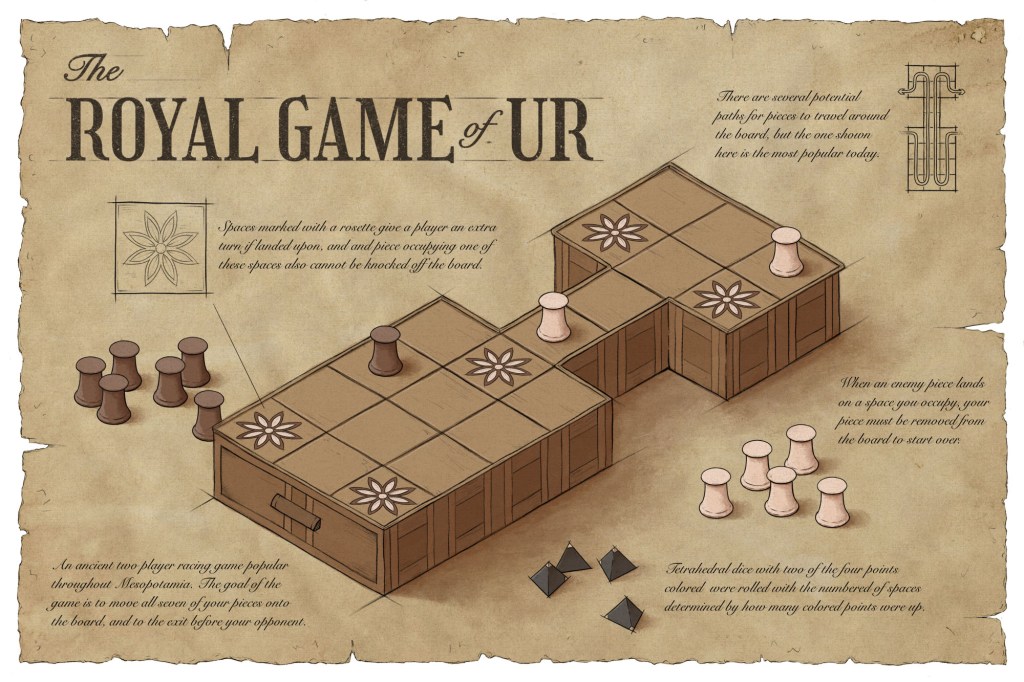
Archaeologists have uncovered more than one hundred examples of this ancient game throughout the Fertile Crescent. The most famous being boards and pieces discovered by Leonard Woolley in the Sumerian royal tombs in the ancient city of Ur. We are unsure of what the original name for this game may have been. But, after the discovery of these boards by Leonard Woolley, today the game has come to be known as The Royal Game of Ur.
This 5,000-year-old board game was not only played in royal courts though, but by everyday people who could easily scratch a board on the ground, or carve it into a paving stone nearby to play to pass the time. The beauty of many ancient games like this is the things required to play them were so accessible that almost anyone, anywhere could play.
This is how the popularity of the game spread across the ancient world, likely by merchants and mercenaries who would carry the knowledge of the game with them from place to place. Any game with simple rules, which required minimal pieces, and is genuinely fun was bound to spread. Interestingly enough, even in the 20th century, there was still a group of Jews living in Kochin, India, who were playing a relative of this game, Asha, all the way into modern times. It is possible that the ancestors of these people had learned about the game during Israel’s Babylonian captivity in 586 B.C. and they brought it with them after they migrated east.
What Happened To It?
With the exception mentioned above, how could The Royal Game of Ur be lost to history after several thousands of years of popularity? While we do not know the answer for sure, it may have simply been a matter of newer games coming in and capturing the world’s attention. Many will point to Backgammon as a possible example of a game that may have caused the demise of The Royal Game of Ur. The excitement of a new game can sometimes cause a classic to sit on the proverbial shelf, and after a few generations, it can be simply forgotten.
Rediscovering How to Play
The problem with a board game everyone knows how to play is there really isn’t a good reason to write down the rules. This is a frequent problem with many ancient board games and The Royal Game of Ur is no exception. For decades people have attempted to piece together the rules, including a young boy in the UK who enthusiastically created his own board based on the one uncovered by Leonard Woolley.
Fortunately, this same boy would one day become a curator in the British Museum, with access to their collection of cuneiform tablets and the skill to read them. In the 1980s, Dr. Irving Finkle began deciphering one of the tablets in the museum’s collection, and he realized what he had was an ancient rulebook for the game he was so interested in as a boy.
The cuneiform tablet was originally written by Itti-Marduk-balatu, a scribe in Babylon around 177 B.C. While some of the rules certainly changed over time and across locations, suddenly we at least had some insight into how it was played a couple centuries before the time of Christ! After years of careful study of the tablet, Dr. Finkle was able to piece together how the game was played at that time, with a simple and more complex version of the game.
Several other people have also attempted to piece together rules for this mysterious game, including R.C. Bell, J.R. Murray, and Dmitriy Skyruk. But, the rule set developed by Dr. Finkle tends to be the one most people play today, in many ways due to a fun YouTube video produced by the British Museum with Dr. Finkle and Tom Scott. The video has several million views and counting and there’s a good chance this video is the reason you ultimately landed on this blog!
The Rules
The Royal Game of Ur would be considered a racing game, like Senet or Parchisi. It is played with two players, using a board with a rather iconic pattern of squares. Each player has a set of seven game pieces which they move around the board according to the toss of throwing sticks or the roll of tetrahedral dice. The objective is to be the first player to move all of your pieces along the path and have each of them exit the board at the end.
One player starts by tossing four throwing sticks, and for each one with the pattern facing up will give them the number of spaces they can move one of their pieces. The roll cannot be divided between multiple pieces.
The pieces enter the board and travel following the path highlighted in the image above. For a piece to exit the board, you must roll the exact number required.
You cannot land on a space occupied by one of your own pieces, but you can move to a space occupied by your opponent’s piece. This removes their piece from the board and forces it to begin its journey all over again.
Following the route, you may land on a space decorated with a rosette. These are special spaces that allow you to throw the sticks again for an additional turn. The rosettes also act as a safe space where your piece cannot be knocked off the board.
Potential Rule Variation
You will find several variations to how to play this game, which was likely the case in the ancient world as well. In my opinion, that’s part of the fun of these old games because you can have fun trying different variants of the game and see which you prefer. A rigid and universal set of rules is a modern idea in many ways. The reality is, even today there are dozens of ways people play backgammon or checkers, depending on where you are in the world.
One simple way to alter the game is to change the path the pieces will travel, particularly near the end. Some have suggested this may be a better interpretation of the path that was historically used, because it reflects the consistent spacing of having a rosette every four spaces. Which is what you see in later boards for the game of 20 Squares.
In this variation of the game, since the rosettes are placed 4 spaces apart, this means you theoretically could move one piece from start to exit in a single turn. But, the since the odds are 1:16 just to roll a 4, then you would have to do it 4 times in a row, and then toss a 1 to allow your piece to exit the board…I wouldn’t count on that as a strategy but it is possible!
Start Playing
The Royal Game of Ur is one of my favorite types of games because it’s easy to explain all the rules in just a few minutes, but has enough strategy involved to keep seasoned players engaged. This makes it an excellent game to play with kids or bring to gatherings with people who may not be as passionate about board games as you. The unique shape of the board always grabs attention, so then you can quickly explain the rules, give a little bit of background to the game, and bring this fun and unique game to another generation.
If you’re a fan of board games and ancient history, then The Royal Game of Ur is definitely worth exploring. With its unique gameplay, intricate design, and rich cultural history, it’s no wonder this ancient game has stood the test of time.


 Kaskal Games